
Strategic Transfers: Blackjack Decision Models in Modern Sports Betting Sequences
Decision trees in blackjack have long guided players through probabilistic choices at the table, and analysts now examine how those same structures transfer to sports event wagering sequences where outcomes unfold over multiple stages. Researchers at institutions focused on behavioral economics track how basic strategy matrices, which map dealer upcards against player totals, translate into frameworks that evaluate live odds shifts, point spreads, and cumulative bankroll impacts across a series of matches. Data from multi-sport betting platforms indicate that sequences involving correlated events, such as consecutive games in a tournament bracket, benefit when bettors apply conditional branching similar to blackjack's hit-or-stand rules, adjusting stakes based on prior results and updated probabilities rather than isolated wagers.
Core Mechanics of Blackjack Decision Trees
Blackjack decision trees operate on fixed mathematical thresholds derived from millions of simulated hands, and experts note that each node represents a state defined by the player's hand, the dealer's visible card, and remaining deck composition. These trees reduce house edge by specifying actions that maximize expected value, with branching paths that account for doubling, splitting, or surrendering under specific conditions. Observers who study gambling mathematics point out that the same logic extends to sports sequences because bettors face comparable information asymmetries and must decide whether to continue, hedge, or exit after each event updates the overall position.
Studies conducted by academic groups in North America demonstrate that professional blackjack players who internalize these trees achieve consistent long-term results, and parallel findings emerge when sports bettors model in-play decisions as sequential trees. For instance, a bettor who places an initial wager on a football match total might then evaluate a follow-up bet on player props only if the first outcome meets predefined thresholds, mirroring how a blackjack player doubles down solely when the count and hand value align.
Mapping Trees to Sequential Sports Wagering
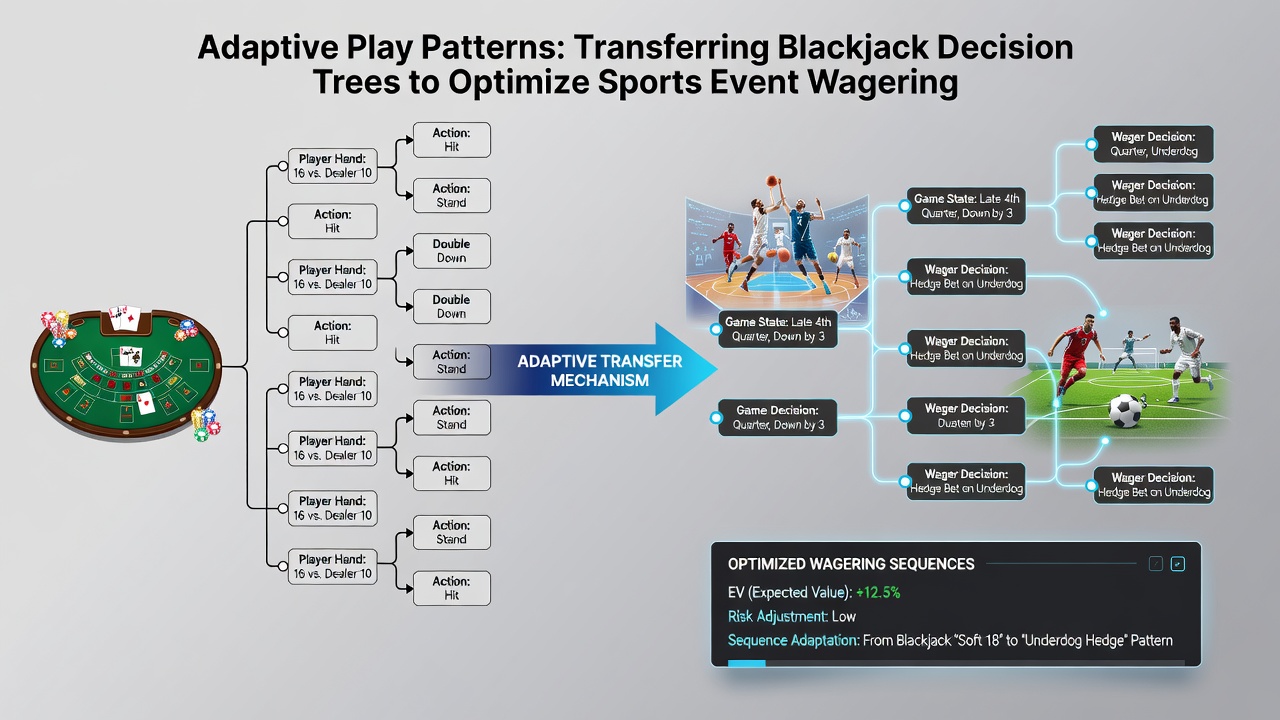
Transferring these models requires redefining states to include variables such as current score, time remaining, injury reports, and live odds movements, while retaining the core principle of maximizing expected value at each decision point. Analysts at European research centers have documented cases where bettors who structured their sequences around blackjack-style branching reduced variance across multi-event parlays. One documented pattern involves starting with a low-variance moneyline bet, then branching into higher-volatility props only when the initial result preserves or improves the bankroll trajectory, a direct analogue to standing on a strong total rather than chasing additional cards.
August 2026 brought new datasets from international sports analytics firms that quantified how such adaptive sequences performed across major leagues, revealing measurable improvements in risk-adjusted returns when bettors incorporated conditional rules instead of static stake sizing. Those who've examined the figures note that the approach proves especially relevant during condensed schedules where multiple events occur within short windows, allowing rapid updates to the decision tree based on real-time information.
Practical Implementation and Observed Patterns
Implementation begins with constructing base trees for specific sports, then layering modifiers that account for cross-event correlations such as weather impacts or team rest advantages. Industry reports from Australian regulatory bodies highlight that bettors using these layered models maintained steadier bankrolls during extended sequences compared with those relying on independent wager evaluations. The process involves defining exit criteria at each node, for example, reducing stake size after two consecutive wins to lock in gains, which parallels blackjack's insurance or surrender options under unfavorable conditions.
Take one researcher who examined data from North American betting exchanges and found that sequences incorporating blackjack-derived thresholds produced tighter distributions of outcomes, particularly when bettors adjusted for momentum shifts mid-sequence. What's interesting here is how the same software tools used to generate blackjack strategy charts now support custom sports trees, allowing users to input live variables and receive branching recommendations that update automatically as events progress.
Data Insights from Broader Research
According to findings published by the American Gaming Association, sequential betting volumes have grown steadily, prompting increased attention to structured decision frameworks that limit exposure. Parallel work from Canadian academic consortia shows that integrating probabilistic branching reduces the frequency of large drawdowns, an outcome consistent with blackjack players who adhere strictly to basic strategy over extended sessions. Observers note that these patterns hold across different regulatory environments because the underlying mathematics remain constant regardless of jurisdiction.
Further evidence from university-led simulations indicates that bettors who treat each sports sequence as a multi-stage game with defined states achieve more stable equity curves, especially when they incorporate bankroll percentage limits at each branch point. The reality is that this method demands disciplined record-keeping and regular recalibration of trees as new performance data emerges, yet the approach scales across sports from tennis sets to basketball quarters.
Conclusion
Adaptive patterns that carry blackjack decision trees into sports event wagering sequences continue to attract attention from analysts and platform developers alike. Evidence gathered across multiple regions demonstrates that structured branching improves consistency when applied to correlated events, and ongoing research tracks refinements as live data feeds become more granular. Those monitoring these developments expect continued integration of such models into betting tools throughout 2026 and beyond, driven by the same mathematical foundations that have guided table game strategy for decades.